
If you run large direct mail campaigns, staying informed about USPS 2026 developments is important for forecasting postage costs and planning future mail volume. You shouldn’t have to wonder if mail delivery will continue for the foreseeable future, too.
Well, don’t—mail delivery isn’t going away.
So, you can keep planning and running your campaigns, even amid occasional news media noise about the U.S. Postal Service’s financial challenges.
Still, you need to stay informed on this important issue with straight facts.
Tracking USPS’s 2026-2027 Financial Situation
One of our commitments at Freedom is to provide direct mailers insight into the best ways to manage the cost inputs, including postage. It’s why we advocate for our clients’ interests on the USPS Mailers Technical Advisory Committee (MTAC) Board of Directors. (You can learn why MTAC matters by following the link below this post.)
Just as we provide MTAC quarterly meeting updates for you, we’ll track this news story. Below we dispel four myths about USPS’s financial challenges, and we’ll provide updates here as this story evolves.
USPS reform efforts are gaining momentum, making relief feel—at the very least—in sight. USPS’s leadership has quite a challenge ahead though, under increasing pressure to address long-standing structural issues.
Myth 1: USPS’s 2026 financial challenges will threaten the viability of direct mail within the next couple of years.
In March 2026, U.S. Postmaster General David 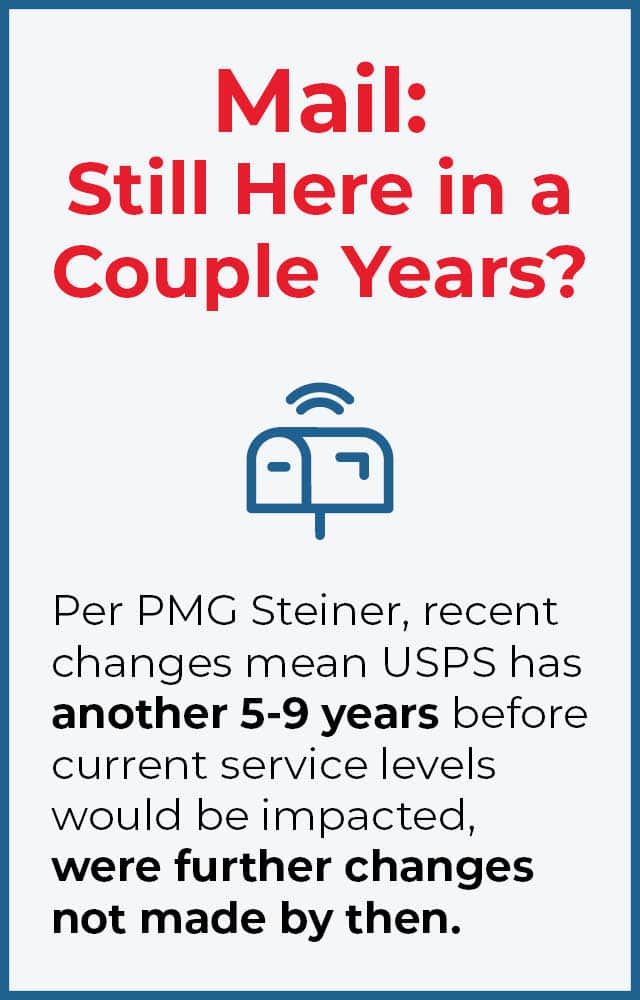 Steiner told the House Oversight and Reform Committee that USPS would run out of cash in less than 12 months. He warned that, unless something changed, USPS would be unable to deliver the mail at that point.
Fact: USPS must fix its structural finances, but it has many years to get the plan right.
On June 24, 2026, Steiner testified before the Senate Homeland Security and Governmental Affairs Committee that a day of reckoning for mail delivery had been pushed back from early 2027 to sometime between FY2031 and FY2035.
Besides restricting nonessential spending, USPS asked the Postal Regulatory Commission to repeal regulations requiring USPS contribute minimum amounts to employee retirement plans. The PRC granted the request. Those moves reportedly bought USPS another 5–9 years before current delivery service levels would be impacted.
This less-than-ideal short-term fix gives USPS, possibly with Congressional help, ample time to develop a permanent solution to its financial challenges.
Myth 2: USPS is ’out of cash’ that it needs to fund its day-to-day operations.
Steiner’s written testimony for the June 2026 Senate committee hearing acknowledged that USPS can continue to operate for years to come, even amidst these challenges. But it also included this statement: “The bottom line is that we are out of cash. We are borrowing from our employees’ retirement funds to continue operations.”
Fact: USPS’s liabilities are growing, but it has enough operating cash to last a long time.
Although it did succeed in drawing more public attention to USPS’s financial challenges, “We are out of cash” was misleading.
USPS’s cash on hand to sustain day-to-day operations is different from accumulated liabilities (long-term financial obligations) for funding employee retirement plans, servicing equipment debt, etc.
- As of the June 2026 Senate committee hearing, USPS had $8.9 billion in unrestricted cash on hand [PDF].
- Meanwhile, it had nearly $31 billion in cumulative defaults through FY2025, which ended on September 30, 2026.
“Defaults” refers to liabilities that USPS would not have been able to cover if they were due as of Steiner’s June 2026 testimony before the Senate committee.
While the gap between USPS’s cash on hand and its accumulated liabilities is a serious long-term financial strain, it’s not an indication that mail delivery can’t proceed.
What does USPS being ‘out of cash’ really mean?
If USPS was truly “out of cash,” it would not have enough money to maintain daily operations—which is not the case. For example, it could not purchase fuel for its trucks or meet the current employee payroll.
This idea may be based on Postmaster General David Steiner’s written Congressional June 2026 testimony [PDF], which contained the statement “The bottom line is that we are out of cash.” Steiner immediately added, “We are borrowing from our employees’ retirement funds to continue operations.” He was referring to USPS’s pause of contributions to the funds to free up more operating cash. Direct mail marketers should know that this less-than-ideal temporary fix has nonetheless improved USPS’s short-term cash position. USPS has until FY2031–FY2035 to implement a permanent plan to address its long-term structural financial strain.
Myth 3: USPS can fix its finances with immediate steps such as cutting Saturday delivery or closing post offices.
Fact: Such changes would involve government-imposed mandates and, therefore, require an Act of Congress.
Title 39 of the U.S. Code states that USPS is a “basic and fundamental service” of the federal government with an “obligation to provide postal services to bind the nation together.”
Accordingly, the Postal Reorganization Act of 1970 codified six-day delivery and instituted the Universal Service Obligation (USO). It mandates mail delivery to every American address, regardless of location—and at uniform pricing.
The Act ensures the delivery of essential items such as medicine. But six-day delivery to 170 million addresses costs $3.4 billion annually, according to Steiner’s June 2026 Senate testimony. And those costs are going up.
The first solution Steiner proposed was changing the law to free USPS from the public mandate. However, this would require the usual drawn-out legislative process. That option could be time-consuming, and a floor vote in either legislative body would not be a sure thing.
Could USPS cut Saturday delivery or close post offices?
No, the U.S. Postal Service is subject to several federal mandates that prevent it from making such changes to cut costs on its own. Such changes would require Acts of Congress. According to Title 39 of the U.S. Code, USPS has an obligation to provide postal services to bind the nation together. That means it must maintain a network of post offices, for example. Also, the Postal Reorganization Act of 1970 codified six-day delivery. The benefit for marketers is that their direct mail campaigns get an extra day and faster delivery in some cases.
Myth 4: To ensure that mail delivery will continue, Congress will need to bail out USPS.
At the June 2026 Senate committee hearing, Steiner felt the choice was clear. He said, “Either allow us to operate as a truly independent agency, free of government-imposed mandates, or pay us for those mandates.” Congress could provide taxpayer support by enacting an appropriation, i.e., direct taxpayer funding. Or—maybe more likely for buying time—it could do something such as provide liquidity by raising USPS’s statutory borrowing limit.
Regardless, expecting Congress to “pay for mandates” amounts to a blank-check bailout if nothing else changes. In other words, throwing taxpayer funding at the problem without reforms would leave the root causes of the issue unaddressed.
Fact: Any Congressional support for USPS would likely come with financial due diligence and structural reform requirements.
During the hearing, Sen. Rand Paul, Senate Committee on Homeland Security and Governmental Affairs chair, requested USPS provide reform plans and due diligence in five operational areas. This would allow the committee to determine any need for Congressional support at current mail service levels.
1. A labor-cost reduction/workforce plan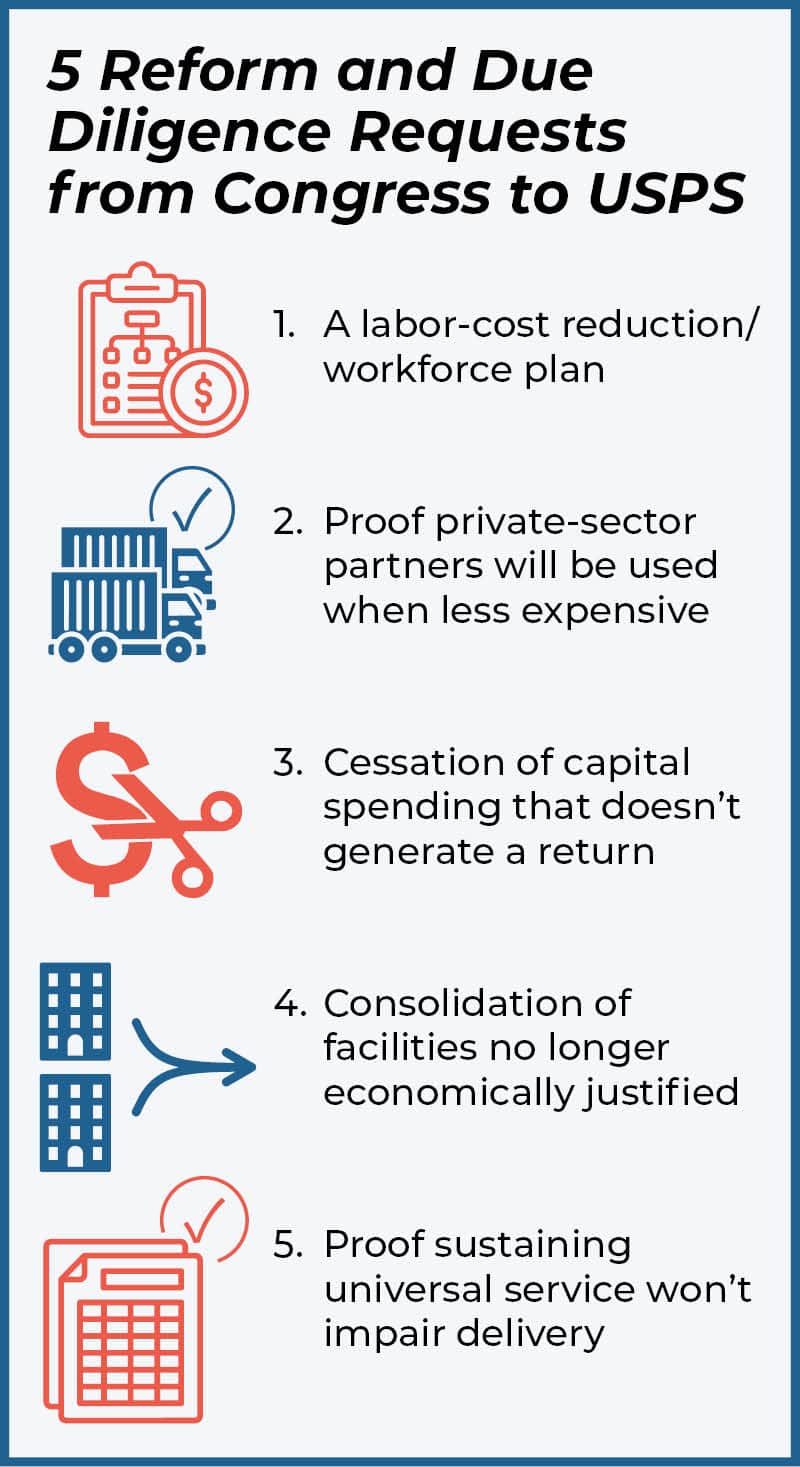
The U.S. Government Accountability Office (GAO) found that personnel costs are USPS’s largest cost category. Compensation and benefits accounted for about 76% of USPS’s FY2024 operating expenses and grew by $1.7 billion in FY2025.
2. Proof that private-sector partners will be used when less expensive
Partnerships between USPS and private-sector companies have precedents:
- For example, in May 2026, DHL eCommerce hired USPS to complete last-mile delivery under a $10 billion+ partnership.
- Also, USPS uses highway contract route suppliers and outsources Contract Delivery Services, the latter particularly for rural or underserved areas.
Still, Congress will likely request evidence that USPS has an astute make-versus-buy framework for choosing the most cost-effective option among private partners, internal employees, or hybrid models.
3. Cessation of capital spending that does not generate a return
USPS’s Delivering for America (DFA) plan, continuing but modified from its original version under former PMG Louis DeJoy, is investing $40 billion to modernize and consolidate the network around Regional Processing and Distribution Centers, Local Processing Centers, and Sorting and Delivery Centers.
According to a January 2026 USPS Office of Inspector General report, these investments have yielded mixed results to date, including inconsistent service performance and financial outcomes short of break-even.
4. Consolidation of facilities that are no longer economically justified
According to GAO, USPS has work to do in identifying facility consolidation opportunities. A February 2025 GAO report found that:
- USPS did not clearly explain the assumptions, risks, costs, and savings behind its consolidation plans.
- In May 2024, USPS paused Mail Processing Facility Reviews (MPFR) until after Jan. 1, 2025, partly because of public and Congressional concerns about consolidation effects. USPS later resumed MPFR activity at a more moderated and scrutinized pace.
5. Proof that USPS cannot meet universal-service obligations without service losses
Falling mail volume and digital competition are exposing the financial challenges built into USPS’s mission.
- Marketing Mail volume fell significantly from FY2008 to FY2023, mainly as digital channels arose and USPS market-dominant postage rates increased. The decline may continue through 2035.
- From FY2008–FY2025, the number of USPS delivery points has increased by 21.2 million, or about 14%. As a result, overall mail density declined from 5.5 to 2.6 pieces of mail per delivery point per day from 2007–2023.
- During the June 2026 Senate committee hearing, Steiner stated that, for 70% of USPS routes and about 58% of the 18,000 post offices, costs outweigh revenue.
Congress wants due diligence numbers showing if, or how, USPS is trying to compensate for these headwinds at the operational level. Informed with these numbers, lawmakers hope to answer the central question about USPS’s finances: how much of USPS’s financial shortfall can be fixed through operational reforms, and how much is the unavoidable cost of providing universal service?
The Path Forward Is Becoming Clearer
Thanks to all these facts, a true picture of USPS’s financial challenges, and the way forward, are emerging:
- Congressional leaders such as Sen. Paul appear skeptical that USPS’s financial challenges are entirely a result of USO, six-day delivery, and uniform pricing mandates—despite being legitimately restrictive.
- Before even thinking of referring the matter to the entire Congress, they need the five items Sen. Paul requested, demonstrated by due diligence numbers. Moreover, the numbers would have to make it clear that these mandates can’t be met without a further adverse impact on USPS’s financial situation.
- In March 2026, USPS briefly hired a renowned restructuring firm to develop a restructuring plan. At that time, Steiner said all options were on the table, including possible service and staffing cuts.
- In July 2026, Sen. Josh Hawley, a member of the Senate committee’s Permanent Subcommittee on Investigations, expanded an existing inquiry into USPS. Among other items, a letter from Sen. Hawley to USPS asked whether USPS planned to release the restructuring firm’s recommendations to Congress or the public.
- USPS hasn’t committed to a deadline for providing Congress with the requested items, according to public records. Specifically, it’s unclear
- when USPS will provide Congress with detailed reform plans,
- whether those plans will align with Sen. Paul’s five requested items,
- or whether the consultant’s recommendations will be released publicly.
A Pivotal Time for USPS Reform
This increased scrutiny is significant. For years, the USPS’s structural challenges have been well documented. What appears to be changing is the level of attention given to evaluating reform options, measuring their financial impact, and determining what role Congress should play in any long-term solution.
For its part, Congress must determine what postal services the nation needs at the current level of mail volume and how much of that service should be financially self-sustaining. But to make the latter assessment, Congress needs financial due diligence numbers from USPS.
Once the needed reforms take place, we expect marketers’ postage rates to become more predictable and increases to occur less often. That will make it easier for you to set your budgets with greater precision so you can continuously execute your direct mail campaigns throughout the year—and do so more profitably.
USPS’s financial challenges are increasingly coming to a head. Congress is now seeking the data needed to determine how much of the problem is operational and how much is structural. The answers could shape the future of mail service and postage costs for years to come.
What is the financial outlook for USPS in 2026?
USPS is financially strained in 2026, but mail delivery is not in immediate jeopardy. USPS has delayed its projected cash crisis [PDF] from early 2027 to sometime between FY2031 and FY2035. It has done so by deferring certain obligations and restricting nonessential spending. For marketers, the main near-term issue is not whether mail delivery continues. Rather, it’s how USPS reform and postage rate increases could affect campaign planning.
Will USPS run out of money in 2026 or 2027?
There is no reason to believe that the U.S. Postal Service will run out of money through 2027. According to June 2026 Congressional testimony [PDF] from PMG David Steiner, USPS had $8.9 billion in unrestricted cash on hand. USPS’s liabilities are growing by the year, so it has a long-term structural financial problem. However, marketers can keep running their direct mail campaigns for several years, until reforms are in place.
Will USPS stop delivering mail?
Because it has $8.9 billion in unrestricted cash, there is no evidence that the U.S. Postal Service will soon cease mail delivery operations. Also, in June 2026, PMG David Steiner told Congress that USPS will sustain mail delivery for 5–9 years [PDF]. USPS has improved its cash position by restricting nonessential spending and pausing contributions to employee retirement plans. Marketers can be confident that their direct mail campaigns can proceed for the foreseeable future.
Does USPS need a bailout?
For the foreseeable future, direct mail marketers need not worry that the mail won’t be delivered. The U.S. Postal Service would not need financial support from the U.S. Congress to sustain its operations for several years. More importantly, Congressional leaders have indicated that USPS won’t receive a “bailout.” They have requested reform plans and financial due diligence in several operational areas so they can determine whether USPS needs support for reforms. They want proof that USPS can implement reforms and still meet its mandates without losing money. Regardless USPS is being forced to implement reforms, with or without Congressional support.
Should marketers pause direct mail campaigns because of USPS financial problems?
Marketers need not pause their direct mail campaigns. Even without measures to improve its cash position, USPS would have enough cash to continue mail delivery until at least 2031 [PDF]. Also, there are signs that reform efforts are gaining momentum. Congress has requested detailed reform plans and financial due diligence from USPS. Lawmakers want to determine whether USPS can meet its six-day-a-week, universal service, and other public mandates without federal funding.
What does USPS reform mean for direct mail marketers?
Direct mail marketers stand to benefit significantly from U.S. Postal Service reforms. The reason is that postage rates will be more predictable. They can budget their campaigns with built-in profit margins further in advance. A profitably operating USPS likely won’t need to increase postage rates nearly as often as it has since 2022. At that time, the gap between declining mail volume and new delivery addresses was widening. It increased USPS’s financial shortfall enough to cause twice-annual postage increases. Direct mail marketers should follow the USPS reform story. It seems to be heading in the direction of a happy ending.
Find out How MTAC Affects your Direct Mail Strategies
The USPS’s Mailers Technical Advisory Committee (MTAC) quarterly meetings potentially have major impacts on your postage costs and direct mail strategies. Our “Why Direct Mailers Should Care About MTAC” infographic explains why. You can also stay current on USPS 2026 developments through our ongoing MTAC updates on our LinkedIn page.
References
U.S. Postal Service Primer – Updated Answers to Key Questions About Reform Issues
https://tinyurl.com/gao-usps-reform-issues
U.S. Postal Service Reports Fiscal Year 2025 Results
https://tinyurl.com/USPS-FY2025-Results
Germany’s DHL Hires US Postal Service for Last-Mile US Parcel Deliveries
https://tinyurl.com/usps-dhl-delivery-agree
USPS Office of Inspector General (OIG) Postal Vehicle Service Operations Audit Report, March 2025
https://tinyurl.com/usps-oig-vehicle-svc-audit
USPS OIG Evaluation of Contract Delivery Services, September 2025
https://tinyurl.com/usoig-cds-audit
USPS OIG Oversight of the Delivering for America Plan Implementation
https://tinyurl.com/uspsoig-dfa
U.S. Government Accountability Office: U.S. Postal Service: Reviews of Proposed Facility Consolidation Costs Met Some Best Practices but Could More Robustly Analyze Risks, February 2025
https://tinyurl.com/gao-usps-facil-analyze
USPS OIG Analysis of Historical Mail Volume Trends, September 2024
https://tinyurl.com/uspsoig-hist-mail-volume
USPS OIG Projecting Mail Volume: Future Trends and Implications for the Postal Service
https://tinyurl.com/uspsoig-proj-mail-volume
USPS Postal 101–Mode of Delivery, March 2024
https://tinyurl.com/usps-mail-density-decline
Reuters, June 24, 2026: US Postal Service tells Congress it needs help, running out of cash
https://tinyurl.com/reuters-usps-congress-help
USPS OIG, Business or Public Service? Insights into the Unique Laws and Regulations Applying to the Postal Service
https://tinyurl.com/usps-laws-regs