
With everything from gas to housing getting more expensive these days, no wonder it feels like there’s nothing we can do to control rising prices. There’s a tendency to think the same goes for direct mail campaigns after the U.S. Postal Service announced the latest postage rate changes that took effect on July 12, 2026… right?
Well, not so fast.
The truth is, your direct mail advertising costs for postage are variable, not fixed. With that in mind, we want to show you how you can achieve postal optimization while preserving the response impact of highly personalized direct mail.
Sometimes the first step in solving a problem is to admit that one exists, or at least grasp how big the problem is. Here’s the question direct mailers at companies and nonprofit organizations need to answer starting in July of 2026: Are your per-piece postage costs $.342 for Regular Marketing Mail or $.147 for Nonprofit Marketing Mail?
Final Postage Costs Are Within Your Control
If you answered no or you’re not sure, you need to know that those postage costs—the lowest in the industry—are based on a combination of factors that are within your control. In this post, we’ll show how you how to minimize the impact of the rate changes and keep your campaigns in line with the industry-best postage cost benchmarks. Those cost-per-piece benchmarks are $.342 for Regular Marketing Mail and $.147 for Nonprofit Marketing Mail.
The path to reaching those cost benchmarks lies in optimizing each of several key variables:
- 5-digit full tray presort
- 5-digit full tray drop shipping to SCFs
- Commingling
- USPS promotions
How the 2026 Rate Changes Will Impact Marketing Mail
Before we show you how to meet those benchmarks, we need to clarify the real impact of the rate changes on direct mail specifically.
USPS recommended another round of postage rate increases as of July 2026. The headlines have announced postage rates going up 4.7%–4.8%, but those numbers can be misleading for direct mailers because they are averages for all mail types.
According to Freedom’s calculations based on the country’s high-volume mailers, the actual average impact of the rate changes is 5.6% for Regular Marketing Mail Letters and 2.1% for Nonprofit Marketing Mail Letters, for example.
Besides the rate changes, July 2025’s USPS structural changes have resulted in a greater reliance on origin entry for some mailers. As the USPS postage “rules” have become more complex, it’s more important than ever for direct mailers to take a holistic approach to minimizing postage costs.
But many direct mailers take a siloed analysis of mail, under-optimize data and mail formatting, and miss promotions. Some mailers don’t even know their postal rate per piece, as their postage is bundled in with other items. As a result, most campaigns fall short of the industry-best postage cost benchmarks.
Evaluate, Then Manage Postal Optimization Variables
Now, let’s go over the postal optimization variables that can keep your campaigns in the industry-best category if you make specific choices to align your ROI to your advantage.
The first step in reducing your direct mail advertising costs via postal optimization is a full mail file evaluation to identify sortation opportunities, entry strategy improvements, and uncover waste that would otherwise exist in the siloed approach. Below, we’ll go over the cost variables one by one. If your direct mail service provider is managing them effectively for you, your final postage costs should meet the industry-best benchmarks.
-
Commingling optimization
The first variable to address in the file evaluation is origin mail. The goal is to only commingle mail that does not qualify for direct entry or drop shipping at USPS Sectional Center Facility (SCFs). That means identifying origin mail pieces at presort levels such as Mixed AADC, AADC, and 5-digit trays that don’t qualify for any 5-digit presort pricing. Based on the July 12, 2026 rate changes, the value of commingling has increased by 17% for both Regular and Nonprofit Marketing Mail.
-
Maximum 5-digit, full-tray sortation
Another key variable is the number of less-efficient mail pieces that can be sorted with other mail owners’ pieces to complete 5-digit full trays and qualify for 5-digit presort pricing.
-
Maximized SCF drop shipping
Maximizing 5-digit full-tray sortation goes hand in hand with the volume of mail that can be directly drop-shipped to SCFs so it qualifies for all USPS SCF discounts. With the July 2026 postage changes, drop ship discounts for SCF have increased 23.5% from $.017/pc to $.021/pc.
-
USPS postal discount promotions
The last but not least important variable is often-overlooked USPS postal discount promotions. Several promotion opportunities remain in 2026, including a 5% Integrated Technologies discount.
New 2027 promotions include Impact Messaging (an incentive to use USPS mailing and shipping services for responses) and Direct Mail Discovery (a discount for mailing completely new pieces or ones not mailed within the past two years).
Achieving Industry-Best Postage Costs
Let’s look at how you can manage those postage cost variables and reduce your costs to the industry-best $.342/$.147 level.
Maximized 5-digit, full-tray presort
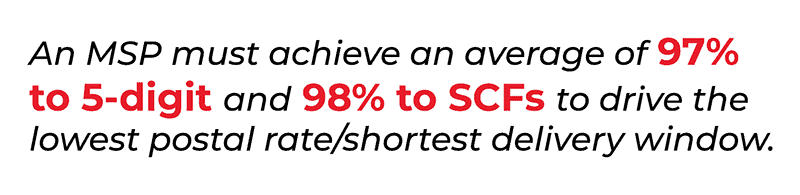
Pre-sortation of mail into full 5-digit trays unlocks the lowest USPS pricing tiers. A mail service provider needs to consistently achieve a 97%+ level of 5-digit pre-sortation in order to drive the lowest postal rate.
Maximized SCF drop shipping
Once sortation is optimized, entry strategy can take over. Industry-best campaigns consistently reach a 98%+ level of SCF drop-ship entry—which not only results in lower postage costs but also more predictable in-home delivery windows.
Optimized commingling
If you only commingle origin mail that remains after maximizing 5-digit full-tray presort and SCF drop shipping at industry-best levels (see below), you’ll optimize commingling.
Fully utilized USPS postal discount promotions
Often underutilized, promotions are one of the easiest paths to reducing postage costs, and in some cases, it can offset the rate increase on its own. We have found that industry-best campaigns reach the 7% level of postage savings with USPS discounts.
Can a mail owner achieve lower rates than $.342?
Yes! You can get your postage costs even below the $.342/$.147 per-piece benchmarks depending on the concentration of addresses receiving the mailpiece within a given carrier’s route. Keep in mind that realizing these savings means you’ll have to prepare your mail file correctly to begin with.
Are you actually hitting those benchmarks?
The latest postage rate changes represent both a challenge and an opportunity for direct mailers to recalibrate their campaign planning so they can consistently meet the industry-best postage cost benchmarks. The time to get started on developing your holistic postal optimization strategy is now.
Not sure where to start? Most programs optimize individual variables. Few can say all of them consistently work together to deliver the lowest possible postage. You can use our Postage Diagnostic [PDF, 439.20 KB] to see whether your program operates that way.